Ah × V = Wh
Always convert to watt hours; that lets you compare batteries at different voltages fairly.
Calculator
Enter your daily consumption in watt-hours, the system voltage and the days you want to bridge without charging. You see the amp-hours your bank needs.
The result is guidance based on your input. Manufacturer instructions and local regulations always take precedence; you remain responsible for the installation.
Amp hours mean nothing without voltage: 100 Ah at 12 V is 1200 Wh, at 24 V twice that. Then some of it goes away. A lead battery is only discharged to about half in practice, lithium to around 90 %, and an inverter loses about ten percent making 230V.
Always convert to watt hours; that lets you compare batteries at different voltages fairly.
Use 50 % for lead or AGM and 80 to 90 % for LiFePO4, depending on how deep you want to discharge.
An AC load runs through the inverter; count on roughly 90 % efficiency plus its own standby draw.
Designing a complete electrical system? In WireElectric you place the battery, charging sources and loads in one diagram, so you can see how the chosen capacity fits the rest of the installation.
You can start drawing without an account.
Open WireElectric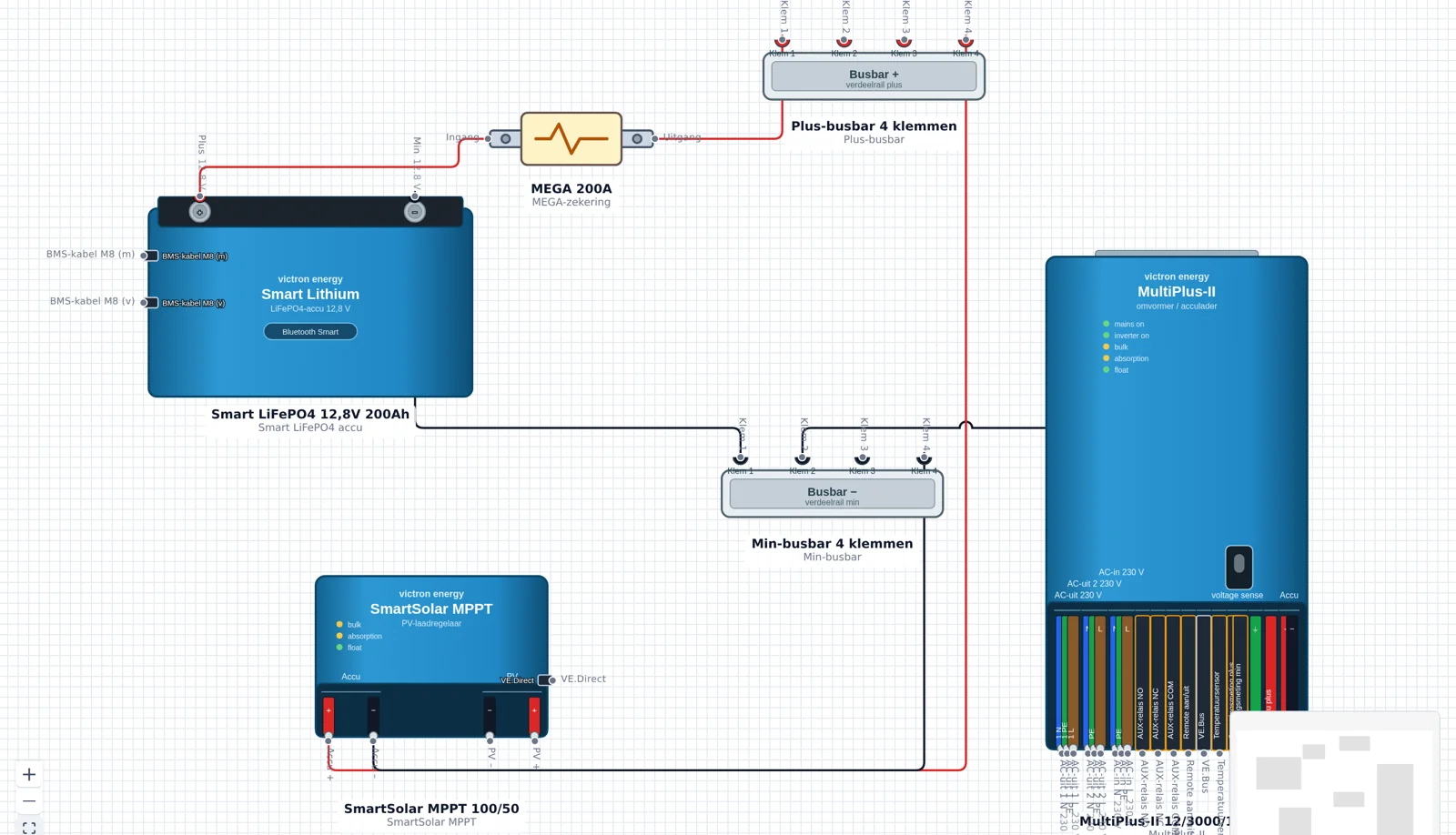
Every calculator answers one question about your installation. WireElectric then runs the same calculations for every connection in your complete diagram.
Find the cross-section that suits your 12V or 24V system, based on current, length and voltage drop.
View →Find a suitable fuse for your circuit, including a check on whether the cable can carry it.
View →Check how much voltage you lose over a cable and what reaches your load.
View →Calculate how long a battery can power a load, including the usable share and inverter losses.
View →Convert power straight to current at 12V, 24V, 48V or 230V.
View →Work out indicatively how many Wp of solar panels your daily consumption needs.
View →