Batteries and banks
Lead acid or LiFePO4, single or in series for a 24V or 48V bank.
Boat and yacht
On board two worlds sit side by side: the 12V or 24V system with service and starter battery, and 230V shore power with a land inlet. WireElectric draws both in one diagram and checks every connection.
Drawing and checking is free and works without an account.
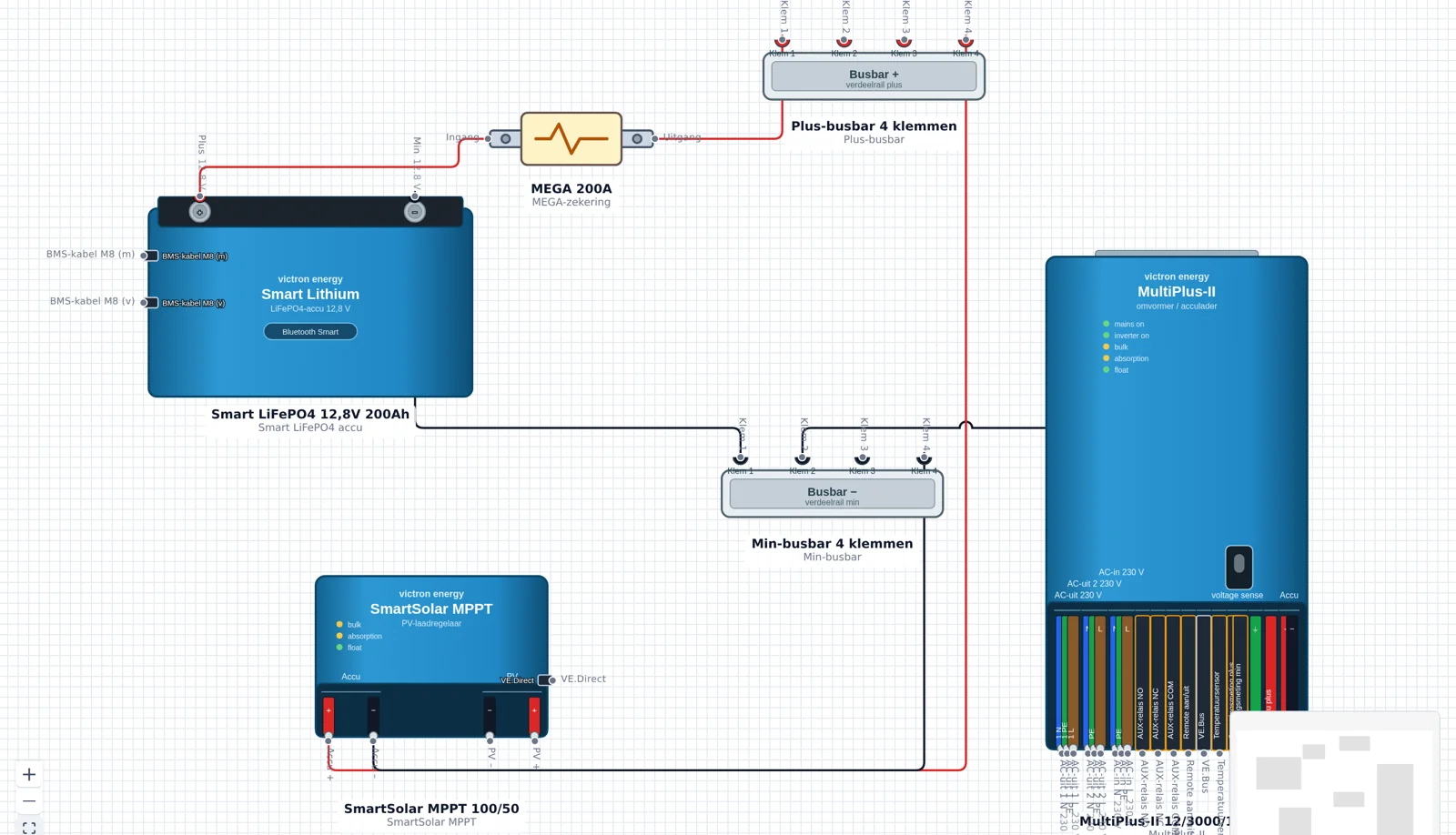
Every part comes from the component library with real ports, voltages and currents.
Lead acid or LiFePO4, single or in series for a 24V or 48V bank.
Panels in series or parallel to a charge controller at the right voltage.
Charge controllers between solar and battery, including Victron models.
Charging from the alternator or starter battery over a DC-DC charger.
From 12V or 24V to 230V for your onboard appliances.
Mains connection with battery charger, RCD and circuit groups.
Lighting, pump, fridge and other loads with a fuse per circuit.
Sockets and fixed connections behind your inverter or shore power.
An Argofet or Cyrix separates charging from consuming. The diagram shows whether the starter battery is being drained.
The land inlet, main breaker and residual current device must be present. The check reports a 230V circuit without earth or protection.
Distances from the battery box to the wheelhouse are large. Voltage drop is calculated per connection so you do not have to guess.
WireElectric calculates along as you connect parts and reports what does not add up.
The required cross-section follows from current, length and allowed voltage drop.
A fuse that does not match the cable or the device is flagged.
Per cable you see the loss in volts and percent.
Ports that do not match in voltage or type raise a warning.
The library contains what is common on board, with the terminals of the real device:
Service and starter battery, each with its own fuse and busbars; at 24V two batteries in series — the app works out the net voltage itself.
Alternator with Argofet or Cyrix, an MPPT for solar and a MultiPlus or Skylla charger for shore power.
Navigation gear, lighting, bilge pump and the 230V part with land inlet, breaker and RCD.
Look at the findings, adjust cables and save or print the diagram for the yard or your insurer.
Every calculator answers one question about your installation. WireElectric then runs the same calculations for every connection in your complete diagram.
Find the cross-section that suits your 12V or 24V system, based on current, length and voltage drop.
View →Find a suitable fuse for your circuit, including a check on whether the cable can carry it.
View →Check how much voltage you lose over a cable and what reaches your load.
View →Work out how much battery capacity in Ah you need for your daily use and autonomy.
View →Calculate how long a battery can power a load, including the usable share and inverter losses.
View →Convert power straight to current at 12V, 24V, 48V or 230V.
View →Work out indicatively how many Wp of solar panels your daily consumption needs.
View →Electrics on a boat are more demanding than at home: moisture, long cable runs, a starter battery that must stay charged and shore power that needs careful earthing. A diagram helps you get separation between banks, protection at the battery and the 230V circuits right up front.
You can start drawing without an account.
Open WireElectric