Batteries and banks
Lead acid or LiFePO4, single or in series for a 24V or 48V bank.
12 volt systems
A 12V system is unforgiving: low voltage means high current, and high current means thick cable, short runs and fuses that match. WireElectric shows you exactly where that goes wrong.
Drawing and checking is free and works without an account.
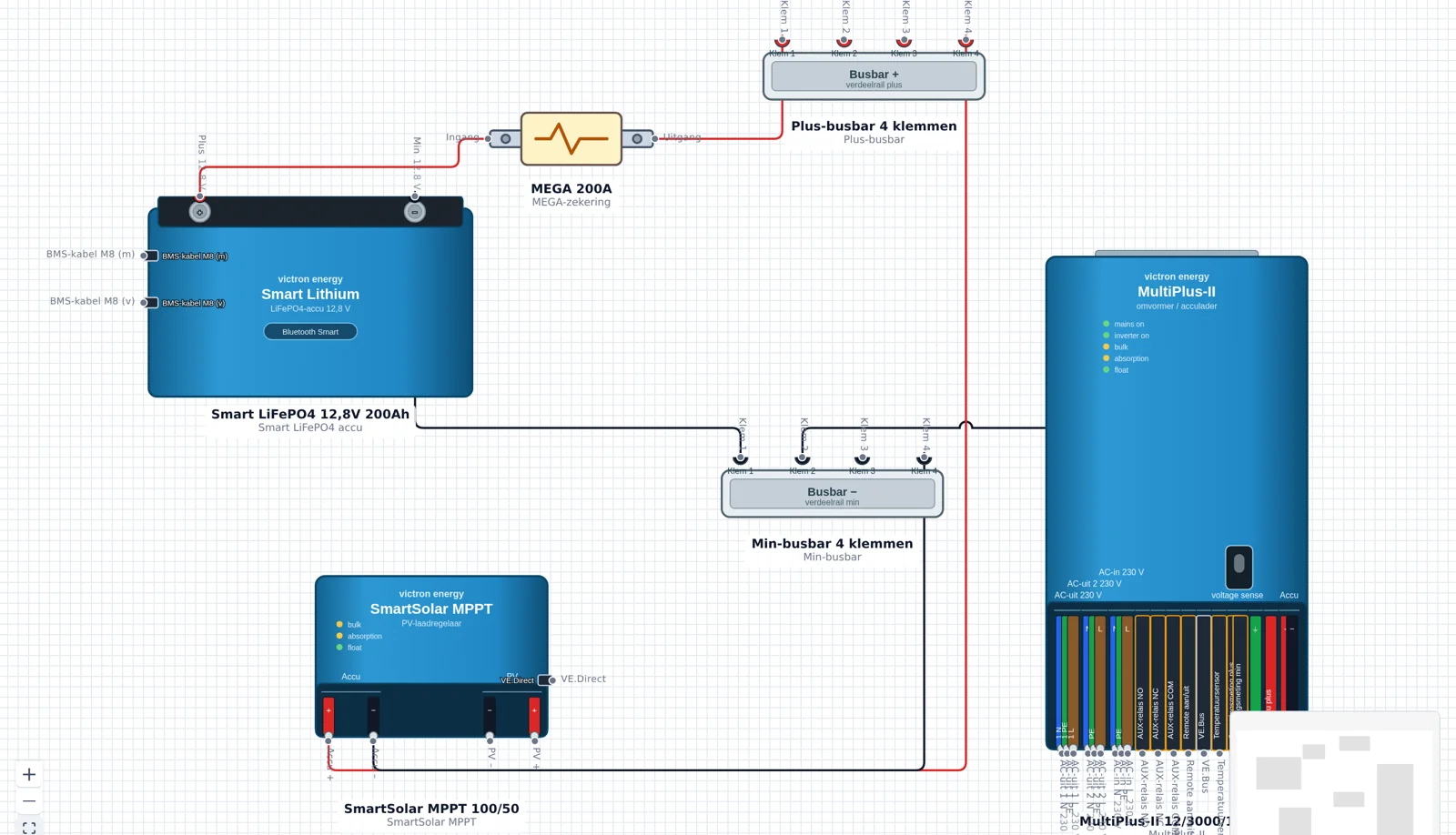
Every part comes from the component library with real ports, voltages and currents.
Lead acid or LiFePO4, single or in series for a 24V or 48V bank.
Panels in series or parallel to a charge controller at the right voltage.
Charge controllers between solar and battery, including Victron models.
Charging from the alternator or starter battery over a DC-DC charger.
From 12V or 24V to 230V for your onboard appliances.
Mains connection with battery charger, RCD and circuit groups.
Lighting, pump, fridge and other loads with a fuse per circuit.
Sockets and fixed connections behind your inverter or shore power.
The check compares the load current with the ampacity of the chosen size and with the voltage drop over the length you entered.
A 100 A fuse behind 6 mm² protects nothing. Per branch you see whether the rating sits between the load and the cable limit.
The negative side is checked as strictly as the positive: every load needs a return path to the source through a busbar, shunt or ground point.
WireElectric calculates along as you connect parts and reports what does not add up.
The required cross-section follows from current, length and allowed voltage drop.
A fuse that does not match the cable or the device is flagged.
Per cable you see the loss in volts and percent.
Ports that do not match in voltage or type raise a warning.
Everything a 12 volt system needs is in the library:
Start with the bank, the positive and negative busbar and a main fuse right at the positive terminal.
Put a shunt in the negative lead and hang the charge sources on the busbars: solar through a controller, the alternator through a DC-DC charger.
Fuse block or distribution panel, switches and the 12V loads with their power rating.
Fill in cable length and size per connection; only then can voltage drop be calculated.
Every calculator answers one question about your installation. WireElectric then runs the same calculations for every connection in your complete diagram.
Find the cross-section that suits your 12V or 24V system, based on current, length and voltage drop.
View →Find a suitable fuse for your circuit, including a check on whether the cable can carry it.
View →Check how much voltage you lose over a cable and what reaches your load.
View →Work out how much battery capacity in Ah you need for your daily use and autonomy.
View →Calculate how long a battery can power a load, including the usable share and inverter losses.
View →Convert power straight to current at 12V, 24V, 48V or 230V.
View →Work out indicatively how many Wp of solar panels your daily consumption needs.
View →At 230V hardly anyone worries about voltage drop; at 12V it is the first problem. A 1000 watt load draws over 80 amps at 12 volts, and over five metres of thin cable you lose so much voltage that the inverter shuts down. On top of that a fuse protects the cable, not the appliance, so its rating has to match the conductor size. The app does that arithmetic per connection while you draw.
You can start drawing without an account.
Open WireElectric